Monday, June 04, 2007

Lost Time

Well, I guess that's just what happens at the end of the school year...I get completely sidetracked by the things that aren't as important as this blog!
Let's just play a little catch- up, shall we, and pretend the whole hiatus never happened!

About a month ago, I read Cat's Eye, by Margaret Atwood. This was a great Christmas gift from the Taosaians (how's that spelling?), and I enjoyed it very much. Is there anything Atwood has written that I won't adore? Probably not, but I'll keep searching and trying. The story is somewhat chilling, and this is the second book of hers (The Robber Bride being the other) where the main character has a fear for women in the next generation that is revealed as unnecessary. The mothers in both books live in fear that their daughters will run into the same troubles as they did -- sadistic girlfriends, empty relationships -- and in both books, the character sees the daughters as a sort of tough hybrid of themselves, not prone to the same difficulties, for whatever reason. As a woman from the generation after Atwood, I find this to be a fascinating idea -- that somewhere between her generation and the one I inhabit comes a hardiness whose origin is unknown. Of course, everyone likes to think they're tougher than they really are -- myself being no exception.

After that, I went on to a novel called The Book of Lost Things by John Connolly. I'll have to remember his name and look into his body of work, because this book was great. The last time I felt moved to tears at the end of a book was when I read A Prayer for Owen Meany by John Irving. (Don't even think about watching the horrific "Simon Birch" movie that is periously based on this fantastic novel -- it's all kinds of awful.) The Book of Lost Things is a quasi-modern fairy tale, reminiscent of Pan's Labyrinth, actually. Very good.

And then I fell into league with a series! Now, one of my guilty pleasures is monster books. Monsters like vampires, werewolves, and the like. Most of them can be pretty trashy, like this series. (I'm not kidding when I say this is a guilty pleasure. I can't believe I'm admitting that I enjoy some of these books in a public arena.) But this latest series I found is just plain fun! It's the Sookie Stackhouse series, by mystery author, Charlaine Harris. Plus, they'll be making it into an HBO series in the fall, called "True Blood," I think. The characters are great, interesting, and it's just great pop-fiction. Makes me feel not so guilty after all.

I also read Holy Fools and Sleep, Pale Sister by Joanne Harris. Holy Fools may be the best book of hers I've read. And I also just finished Daughter of Fortune by Isabel Allende. So even though I've been silent in cyberworld, I have been devouring those books and keeping up with my reading. Swear.
Now that summer is upon me, I know I'll have more time to write about what I'm reading. I just went to the library today for more Atwood, some Michael Pye, and Barbara Kingsolver!

Sunday, April 08, 2007

The Devil in the White City by Erik Larson

One of the many books I've received as a gift was a Calvin and Hobbes collection from my step-dad. I don't know where he got it -- it's quite possible that it was a golden find at a garage sale -- but I remember that when he gave it to me, he told me not to keep it. Being a book lover, I was surprised. Not keep a book? But I love books! Of course, my step-dad had a different plan. He thought my collection could be a "friendship" book, something to pass along to someone else when I was done reading it -- instead of spreading gossip to two friends, spread the fun witticisms of Calvin and Hobbes.
I can't remember what happened to that particular book, or whether I took his advice or not, but this spring when I was at jury duty, I was given a book by someone I would never see again, and whose name I don't even remember. We were on a trial, and were trying to find something to talk about during lunch that would have NOTHING to do with the trial (very difficult with complete strangers, it turns out), and we started discussing books. I recommended some, he recommended some, and I soon had many new titles to audition.
But the next morning, my jury friend surprised me. He had brought me one of the books he recommended, and told me to read it. I hesitated while taking it, concerned about how to return the book, what to do with it, should I even accept it? But my friend had already thought of that, and told me to just "pass it on" when I was done with it.
So now I've finished it, and it was a fantastic book! Well worth passing on to anyone! First it goes to Buckwalter, but after that, it's any one's game!


The book was The Devil in the White City by Erik Larson. It intertwines the captivating story of the creation of the Chicago's World's Fair and the sadistic tale of a murderer who took advantage of countless visiting women who traveled to view the fair. I am not usually someone who enjoys nonfiction, but the weaving of stories and the color Larson uses in describing characters, buildings, and meetings are intriguing at the least.
His depictions of the murderer, Dr. Holmes, were so chilling at times, I found I really couldn't bring myself to read the book before bed.
The most interesting feature was the architectural interests of both main men. Mr. Burnham, the main architect of the Fair, struggles with his vision for a perfect White City in the heart of a slum-loving Chicago, while Dr. Holmes struggles to create a building of the macabre, with gas chambers, cremation ovens, lost corridors, all without having any of builders' suspicions aroused.
So perhaps when Buckwalter has finished reading it, you'd like to have our copy. Just remember to pass it along when you're done!

Wednesday, March 14, 2007

Angela's Ashes by Frank McCourt & You Poor Monster by Michael Kun

It's been such a long time! Well, needless to say, in my month and a half respite, I have read many books, several of which I have no desire to mention or talk about. There's just not much to say about some of them.
I did read Angela's Ashes by Frank McCourt while I was on jury duty and a trial for 3 days. It wasn't exactly a release from all the violence I heard about during the trial, but it was an incredibly rich memoir. It was a troubling tale that left me a little confused at the conclusion. What exactly did McCourt want me to understand from his story? Certainly there is quite a bit of forgiveness stuffed into each pint that his father drank, but I don't know if I as the reader was ready to forgive and move on by the end of the book. Regardless, I loved the simple elegance of his similes, especially where stories and books were concerned: "I don't know what it means and I don't ca re because it's Shakespeare and it's like having jewels in my mouth when I say the words."
After my jury duty was all closed up, I returned back to normal life and a new book, oddly enough about a lawyer and his eccentric client. The book is called You Poor Monster by Michael Kun and, just like with McCourt's book, I truly enjoyed it. The story rises and falls, and the reader is a few slopes behind the author every time. For example, the novel has endnotes, which you are instructed to read or not read, at your leisure. Well, folks, I should have read them. I know that now. But it's too late for me -- save yourself! As you read this novel, read the endnotes as they come! It will seem inane at first, but the payoff will come. Oh yes -- it will come.
Now I've moved on to a book called Devil in the White City by Erik Larsen. This book was actually given to me by one of my fellow jurors. I thought that was extremely generous of him, since he would never see me (or his book) again. I was instructed by my fellow juror to donate it to the library when I had finished. Seeing as you are all my loyal readers, if you'd like to read it after I've commented, you may request it! Perhaps I can donate it to the "Literary Time Out" Library of collected books. Or perhaps I can donate it to you! Stay tuned...

Sunday, January 21, 2007

Wolf Boy by Evan Kuhlman

My original intention was to write a little blurb about every book I read. That intention has fallen by the wayside as the school year battles on and my time at the computer becomes scarce. So I've skipped over two books in order to keep up to date with my thoughts and my more current readings. The two books were Robber Bride by Margaret Atwood (lovely, as always, and quite intricate) and Plainsong by Ken Haruf (lonely, bleak at times, but satisfying in the end.) I just didn't have much to say about either of them, and had soon moved on to the next book.

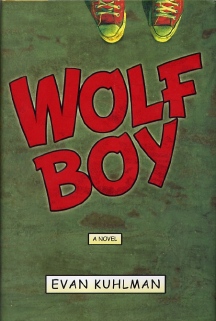
The next book this time around was Wolf Boy by Evan Kuhlman. I am a firm believer in judging a book by its cover, and many, many times have used this old backwards adage to chose the next book I will read. But just look at this cover:


I was helpless to resist. I picked it off the shelf and carefully, gingerly even, opened the book to see that within the pages and pages of words rested scatterings of a graphic novel.


The book is sweet and touching and still somehow avoids that maudlin touch that plagues all novels about grieving. In the story, a young man is killed in a car crash, and the novel follows the immediate effects of his death on his family. One of these effects is the creation of Wolf Boy, the comic book character, by the grieving brother.
The most interesting and honest moments in the book occur as the reader watches the parents of the boy deal with his death. The mother completely loses any sense of herself, and the father tries to be open with his grief and just ends up making everyone uncomfortable. The novel explores the idea that everyone deals with grief their own way. This truth is something that makes funerals always uncomfortable and difficult -- besides the obvious fact that a loved one has just died. You are always expected to push yourself into someone else's idea of what it means to grieve. And that springform pan does not fit anyone perfectly.
The family doesn't reach any definitive change in the end, but the realism of that ending is just the kind of thing that draws me to this book. Sometimes I look for a lack of reality in a book, but every now and then it's nice to feel the mirror of the novel turn towards humanity.

Sunday, January 07, 2007

What Was She Thinking? [Notes on a Scandal] by Zoe Heller

With the building boom in Las Vegas, there have been many job opportunities for all kinds of people. It's been a new golden age for the city. One portion of the population that has benefited job wise from this boom is the high school kid. Each builder hires several kids to stand on different street corners, holding signs shaped like Muppet-sized arrows displaying the builder's name and nearby community.
Sounds like a boring, mindless, thankless job. I'm sure it was. Until the kids started becoming Cirque du Soleil jugglers with these mammoth signs. I've seen kids twirling them in the air, throwing them like batons, and even twirling them between their legs. And with the crowds of cars driving by, it's like a movable Olympic gymnastic feast -- only everyone forgot their score cards.
Today, as I was driving home from the library, I had the unusual experience of watching someone try to flirt with me from outside my car. One of these sign kids, an older high school boy, was twirling away until he saw me drive up into the turn lane nearest him. While watching for traffic to clear up, I glanced his way, to see a toothy grin on his face as he stared right at me. He extended his arm and pointed at me, winking. Not wishing to be rude, I tentatively waved back, and he nodded, laughing at my hesitation. Then, the traffic cleared up and I drove on, shaking my head, and laughing myself.


I haven't had a young person flirt with me in awhile, but it brought to mind the Zoe Heller book I read recently. In the book, now made into a movie called "Notes on a Scandal" starring Judi Dench (genius casting at work there) and Cate Blanchett, a young, inexperienced teacher starts an affair with one of her students while an older teacher comes to her aid in a self-serving manner. The book does a superb job of starting the affair off with innocent situations and continuing along in a hyper-realistic plot line.
Also, as an educator, it's very interesting to watch the whole situation unfold and listen to the ruminations of the main character on education and its current state in the world. You read at first in empathy as the young teacher just wants to help her students yearn to learn. You read later in uncomfortable twistings as she befriends a student, knowing what is going to befall her. Lastly, you read in horror as she makes elegantly terrible decision after decision, and you wonder, "What was she thinking?"
I did worry as I scanned the bar code at the self check library station -- will I get in trouble for reading this book? Is the government watching my book selections? Will I receive a phone call in a few weeks from Homeland Security, expressing curiosities about my recent readings? So far so good, but I admit I have been checking the Caller ID more carefully than usual.

Wednesday, December 20, 2006

The Penelopiad by Margaret Atwood

There was never any possibility I would not love this book.


First of all, it was written by Margaret Atwood, who is quickly running up my list of favorite authors.
Second of all, it's a re-telling of The Odyssey by Homer, who Margaret Atwood still has to contend with on the tournament list of my favorites.
The Odyssey has long been a beloved book of mine. I love the language, the gentle sway of poetry, the everlasting quality of the story. My freshman year in college, I spent much of J-Term reading The Odyssey aloud with a friend of mine while he worked at the front desk. Buckwalter and I also read from it one summer in Thorson while trying to combat the humidity by holing up in the lovely limestone lounge. Suffice it to say, the book holds many memories for me between its passages.

Atwood focuses on the hangings of all of Penelope's maids at the end of the book. Her unrest over this execution breathes on every page of the book. Atwood even states in her foreword that she has always been troubled by why these girls had to die. To me the tale of the Odyssey is so deliciously blood-soaked anyway, I actually never really paid much attention to the ending of the maids. Especially since it's barely a footnote after the raw slaughter of the suitors...I may have still been heady with the rush of that carnage to care too much about the next stanza.
The striking point for me in Atwood's retelling was twofold: her depiction of Penelope creates a realistic, thoughtful and honest woman, straying slightly from the more love-torn crafty Penelope of the Odyssey; and Penelope tells her whole story from inside the Underworld, where she happens upon the suitors, arrows still sticking out of their throats, hubirs still dripping with certainty down from their necks with their thick blood.
Truly, there was no way I wouldn't have loved this book. Truly.

Thirteen Moons by Charles Frazier

I spent about a month waiting for this novel to appear at the library for me, and finally, when my waiting was up, found out I had only two weeks to read this thick stack of paper. This proved quite impossible. For those of you who have read Cold Mountain, you are familiar with the dense descriptions, complicated characters, and often confusing passages of events. For those of you who only saw the movie starring Nicole Kidman and Jude Law, you are probably still reeling from the graphic sex scene...I know I am.
I will say from the outset that I expected much more from this novel that I received. Charles Frazier creates another wondrous character with quite the odyssey before him, but attempts to use the scape of a whole life to tell the man's story. Trying to incorporate so many events of such differing timbre and still have a compelling through-line doesn't work for Frazier. I did find the love story to be lyrical -- our main hero and his Claire, she of the silver bracelets make an empathetic couple -- but because the novel is taking us through the span of an entire life, the love story gets cut short.
All in all, if you wish to read a book like this, I would recommend Any Human Heart by William Boyd. It is one of my favorites, and works where Frazier has -- failed is a strong word, so we'll go with -- not reached this reader's expectations. This is of course the trouble with such a strong first novel -- you'll be watched closely on the second try.

Sunday, November 19, 2006

Female Chauvinist Pigs: Women and the Rise of Raunch Culture by Ariel Levy

It is amazing what social phenomena you are able to give name to after letting the Dish into your home. Suddenly, I am innundated anew with comedic news from the Daily Show, restless showboating from the Colbert Report, and angst-driven commentaries from Real Time with Bill Maher. This particular author was on The Colbert Report, and what a gem. After an overtly swaying interview, I was pumped to check out this new book. Just this summer, I had read Get to Work: A Manifesto for the Women of the World by Linda Hirshman, and I was enthralled. You get one guess as to on what TV show I saw her being interviewed. Stephen Colbert must have the newsworthy nose of a bloodhound.

After seeing Ariel Levy, a younger, seemingly flighty woman interviewed, I hopped on the library website and put myself on the waiting list. This idea of "Raunch Culture" is an enchanting term to a societal problem. As an 8th grade teacher, I see this side of culture waiting around every classroom corner, sprawled on the front of every binder, and written on every young girls' T-shirt. A prime example is a young woman who walked into my class earlier this week, very polite and full of smiles. Trouble was, she was also wearing a faded green T-shirt (possibly the type you buy from Old Navy that is their "vintage tee") that said in bold, white letters, "GUESS WHAT MY FAVORITE POSITION IS." That's fairly raunchy, I'd say. Or there are these lovely statements to be made also. Imagine what the school climate is like when 80% of girls are wearing t-shirts like this, and their parents do not understand the problem with them.

In the book. Levy takes awhile to make her assertive and ridiculously radical point. About halfway through, when she began to bitterly quote Camille Paglia and raise up the confused and ultimately divisive figures that we know today as "feminists" (Gloria Steinem: "A woman without a man is like a fish without a bicycle;" Susan Brownmiller: "It is a horrible truth, but the one thing we know now, that men didn't want us to know twenty, thirty, forty years ago is that it is not our fault. It is their fault."), I suddenly became very anxious about where Levy was going with this and what exactly her ultimate conclusion would be.
It's nice to look back on your future with a book and be able to say, "We had some tough times, book, but in the end, you gave me what I wanted and never expected! Thank you!" Levy moved on from the awkward discourse about "The Future that Never Was" and back on track with her message. (Before clicking the links included in the following sentence, make sure you are ready for a serious delving into the heart of the beast. In other words, those links are not work safe). She discusses the Girls Gone Wild creation, the inception and prolonging of Playboy, and the sexual fervor exhibited (quiet literarlly) by a group called CAKE. After she jumps head first into this cream-corn wrestling tub, Levy becomes emboldened by her ideals, and comes down fully on the whole concept of Raunch Culture as some sort of liberation. Some of my favorite quotes from the book:

On the radical shift in young girls to vie for position of the "most skankiest" rather than be embarrassed by sexuality: Adolescents are not inventing this culture of exhibitionism and conformity with their own fledgling creative powers. Teens are reflecting back our slobbering culture in miniature(146).

On abstinence-only sex education: If I, as an adult, find this kind of educational exercise unconvincing, shame-inducing, and lame, imagine how well it works to influence the impulse control of the average teenager, who (I like to think) is less rational, less self-aware, and more hormonal. In addition to being laced with misogyny (do you want to be defiled like Miss Tape or do you want to be a nice, clean, thin virgin?), the abstinence-only approach has the disadvantage of being unrealistic(160).

A quote from Erica Jong, author of Fear of Flying: I would be happier if my daughter and her friends were crashing through the glass ceiling instead of the sexual ceiling. Being able to have an orgasm with a man you don't love or having "Sex and the City" on television, that is not liberation. If you start to think about women as if we're all Carrie on "Sex and the City," well, the problem is: You're not going to elect Carrie to the Senate or to run your company. Let's see the Senate fifty percent female; let's see women in decision-making positions--that's power. Sexual freedom can be a smoke-screen for how far we haven't come(195).

The book is fascinating in its depth, conclusions, and creative nonfiction stories. Ultimately, Levy boils the whole mess down to one simple idea: since we are all individuals, how can we expect this one simple and plastic image of female sexuality to even come close to liberation, let alone express the sexuality of women as a whole? As she states, Women's liberation and empowerment are terms feminists started using to talk about casting off the limitations imposed upon women and demanding equality. We have perverted these words. The freedom to be sexually provocative or promiscuous is not enough freedom; it is not the only "women's issue" worth paying attention to.
Well said. Might I recommend that after you read Levy's book, stress this issue to the publishers of America, and read Linda Hirshman's book too. There is more to women than "sex symbol," and no one needs to understand that more than women themselves.


Sunday, November 05, 2006

The Poe Shadow by Matthew Pearl

Around Halloween, I'm always looking for a book that will spook and surprise me, trick and treat me. When I saw that Matthew Pearl, author of The Dante Club, had written a new novel, I was ready to greet him at the door, jack-o-lantern full of Kit Kats at the ready. The Dante Club is the kind of novel everyone believes The DaVinci Code to be -- violent, mysterious, adventurous, and brimming with mysticisms and occult findings. The Poe Shadow left me not only lukewarm towards the main character, a very human but belligerently dim-witted and trusting man, but also disenchanted towards any conclusions the book drew.

The main question: with such a captivating nonfiction basis for this book, why was I not more fascinated?


The book uses new evidence to conclude a probable end to Edgar Allan Poe. Any conclusion that the author came to was completely lost on me. I felt as though Pearl and I were walking around in circles, following Quintin on some irreverent chase of the macabre, with neither an end in sight or a beginning in the past. Facts were shared willy-nilly and characters turned and twisted with seemingly petty reasoning. By the end of the novel, I was just happy to have finished. Poe Sho.
Unless you are an Edgar Poe groupie with extensive background in both his life and the mysterious circumstances of his death, think twice before you fetch this novel from the library. Consider The Dante Club instead...at least there you have some authors that solve the mystery.

Sunday, October 15, 2006

Wickett's Remedy by Myla Goldberg

Besides checking out books from the library, Buckwalter and I have also found a welcome respite from network TV by checking out several DVDs. Having a Halloween birthday has created in me an interest in the macabre, the otherworldly, and the paranormal. So we recently checked out a show from the SciFi channel called Ghosthunters. The basic premise involves two plumbers who, because of their personal experiences, spend all their free time looking for evidence of the paranormal with a group they created called The Atlantic Paranormal Society (TAPS). These two links don't do the show, or the gentlemen, any credit -- the show is frantically interesting and the two main men -- Jason and Grant -- are adamant in their search for substantial evidence. They look for every possible explanation before they make any conclusions on their multimedia.
This show, like any spooky show, created in me a sense of unease, based off of the evidence they found. The pictures and videos are just interesting...but the EVPs are eerie and make my heart beat a little faster.


Which brings me to Wickett's Remedy...from the author of Bee Season, a book that I owned for 5 years before reading. The story is about a young woman in Boston during the 1918 influenza epidemic. The story is sweet, charming, and lovable -- but it was the haunting margins that made an impact with me. As I sat down to read the book after just viewing an episode of Ghosthunters, the quips in the margin of the book became more and more clear. The margins in Wickett's Remedy are the voices of the dead, correcting the memories of the living, expounding on their tellings, and adding their own two cents. I had a vision of the characters in Our Town, all properly seated on their tombstones discussing the weather. The margin speak is not creepy -- the realization of what you are reading is startling -- but the dead only wish to make sure the story is told accurately and by all speakers available.
Despite the sweet love story, the tender family moments, and Lydia's own growing confidence, the book resonates with an uplifting grieving song. For anyone who has lost a close friend or family member, it is a book that will restore a little of the confidence you lose when they are gone. For anyone who, during the constant chatter of the human mind, is unsettled by questions of life after death, the book will add some bravado to your spirit. For anyone who wonders whether those who are gone can still love and wish for you, it will not let you down.
I loved it. Nothing more can sum it up.

Wednesday, October 11, 2006

The Red Dancer: The Life and Times of Mata Hari by Richard Skinner

Now I have to face head on the perils of reading binges...the lukewarm novel.
I have known the name Mata Hari and had vague ideas about her life since middle school. In middle school, I was entranced with Rocky and Bullwinkle, and acquired, through thoughtful presents, videotapes of old episodes. Fractured Fairy Tales, Ask Mr. Know-It-All, Dudley Do-Right, and all the best of cartoon sketch comedy. One of these fabulous treats had a semi-educational, googly-eyed look at history: Peabody's History.

There was a particular episode of Peabody's History (pictured above, Mr. Peabody on the left for those among the uninitiated) which featured a cockamamie history of Mata Hari, in which she gave secret plans to the German army. Eventually, though, her careful plotting against the bumbling British was waylaid by Mr. Peabody and Sherman, who stopped the German army by skewering a hot dog on the end of each soldier's bayonet... causing the foolish followers of the Kaiser to believe they were at a wienie roast.
Ever since soaking in this phantasmical feature, I've been curious about Mata Hari. It's a name that you hear, synonymous with femme fatale, but I have never actually known anything about her. The only other information I had on the infamous spy was a pot-crazed write-in of the character in a David Niven/Woody Allen/Peter
Sellers movie called Casino Royale. It's the strangest of all the sixties pop-adelic movies that I've seen, but, with music by Burt Bacharach, is one of the best soundtracks for homework. More of my calculus problems were solved with the serenade of a flugelhorn than by any other tunes.
All rambling aside, these were the only views I had of Mata Hari -- hardly historical, and barely breathing on the truth. So when I saw this spine stretching out towards me at the library, my brain tingled with anticipation. Finally! I would know the actual history of this character! At last my chance had come!


But this novel turned out to be only slightly more informative than Rocky and Bullwinkle. It begins with her deliberate marriage into the Belgian Army, followed by family tragedy that ends in divorce. Then we see her become the dancer that she's known as, and follow her through those upcomings. At this point, I was hoping to know more about how she became a spy and what exactly she did for the Germans. The set up of the novel prohibited this knowledge from creeping off the page and into my head. Every chapter is told by a new person who knew Mata Hari at that point in her life. This makes the actual plot line of the novel drift and ebb with no consideration for presenting the facts clearly. I learned a few interesting things, not the least of which was Mata Hari's skiing accident. She was stranded in the mountains with her ski instructor overnight, and had to construct a hole in the snow so they could keep warm, and was actually saved by a man who used dowsing rods. But while reading this novel, I spent most of my energy just trying to understand how this new person connected to Mata Hari, and comprehend their importance in her life.
Of course, the main facts were presented, and I did learn a little more through them. But I disapproved of the constantly varying first-person narrative. It veiled the pressing information just like one of Mata Hari's scarves. It's nice to know another reader felt similarily, but I still feel that this book just needed some constructive criticism pre-publishing.
There was one cozy delightful moment of a love story between Mata Hari's maid and gardener. It was so sighingly sweet that I can't help but reproduce it for you here.


He said he had another surprise for me. He took my hand and led me upstairs. In my room, he tied several pieces of blue ribbon to the window catch and opened the window. They fluttered in the breeze. He said we had to wait until just before daylight faded. We lay on my bed together and he kissed my neck. He whispered flatteries in my ear and said, "Sex without love can be an empty experience, but love without sex is a waste of time." He loved talking in riddles. Just then, I noticed a butterfly by my window. Its wings were the palest blue and had black edges. Soon, there were six or seven butterflies, all flapping around the ribbons. He smiled and said the ribbons attracted the butterflies to mate. That night Hippolyte stayed with me. It was the sweetest night of my life.

Judging from this lovingly, sparse romance, Mr. Skinner might actually have a prolific career lined up with these publishers. Just like Ms. Hari, let's hope he leaves the espionage to other authors and seeks a better mate for his strengths in romance.


Friday, October 06, 2006

Everything You Know by Zoe Heller

I'll clue you in on my prospective idea here:
Since the library has recently been reborn for me, I've been inspired to look back to my more literary days with more intelligent, controlled posting. It has seemed like the majority of my posts over the last year since our move here have focused completely on what was happening in my day...admittedly, nothing really worth posting about, since I never want to put TOO much information about my profession on the internet, lest some little child put two and two together. This would be quite the feat, since I subbed in a math classroom recently, and...well, we'll just leave it at that. I love to tear through books, especially after spending my day reviewing the parts of speech with my little freaky darlings. So it's big kids literary time here...time to review the thoughts of the day through the books of the hour.

Everything You Know...as I read this book (see summary here), I felt the masculine attributes in myself being drawn towards the sparse prose, dully vivid descriptions, and minimized realizations. One of my favorite small moments was a momentary brain jolt from the main character, Willy, as he watches the woman next to him sleep: "I watched a tiny tear of sweat making slow progress down the side of Karen's neck. Slightly creepy, that--the way the body keeps on doing its work while you rest: rumbling and oozing, the city that never sleeps. It would be more satisfactory if it shut down when your mind did." Moments like this in a book are bandaging to a bad day...that feeling of "oh, someone else too?" I have the nasty habit of waking myself up from naps because of the wetness of drool on my cheek. Give me a little credit here -- I am not a complete sleeping slob. This is only when I have fallen asleep on the carpet or on the small couch because my eyes can't stay open past 4:45.

Of course, there are more intimate realizations at work in the book: "We are taught very early, and most of us spend our lives believing, that there is a sliding scale of duplicity in life...well, the truth is, duplicity doesn't lend itself to any such neat system of evaluation." Insightful.

All in all, a good read -- the author bandies between letters from a dead daughter and the thoughts of the live father. The epistelary book is an artform that is resurging in effort, but not in completion. Most of the books I've read have some air of Frankenstein, Dracula, and Dr. Jekyll and Mr. Hyde to them, but don't go whole hog. They have a strong narrative built around the newspaper articles, diary entries, and letters. Somehow it's just not the same as, "To Ms. Saville, England: August 5th, 17--. So strange an accident has happened to us that I cannot forbear recording it, although it is very probable that you will see me before these papers can come into your possession."

Thursday, October 05, 2006

Alias Grace by Margaret Atwood

I am completely on an Atwood binge right now. Well, actually, I was for the last month, and plan to binge again in the upcoming month. Atwood binge and purge, we'll call it.

This book was fantastic. Just like The Blind Assassin, I was intrigued by a slight change in tone and the movement of words about 2/3rds through the book. Quite suddenly, you realize that something's different than you've expected, and has been all along. The surprises that she holds till right after you sense them are not that surprising. It's no Conan-Doyle impossibility -- the reader can see what the other characters are seeing, and is able to move along with them in logic and sensibilities. I just love an author who gives you credit for being
intelligent and gives you the tools to move to her sways.

Check out the summary here, if interested.

Some folks are hesitant to step into an Atwood book because she has been labeled "a feminist writer." This is such a meaningless label that I wouldn't pay any attention to some such press. The word "feminism" is so bastardized and split open in current society that God only knows what someone means when they say that. For my part, I wouldn't hamper her down with any label of that sort. Don't be fooled by some of the topics this book tackles...she certainly has substantial remorse for the character of Mary and her predicament (see the excerpt), but she has just as much remorse for the slighted character of the Doctor, involved in an affair that he would like to end. If you think of feminism as a "girl power," women are better than men term, then you will agree with me
that this point is hardly on her agenda. She positions characters in such a manner that every gender, age, and class is given the chance to seem human, and only human. Mistakes are made, all of them believable, and on all sides of societal issues.

That's the beauty of her work. Especially Alias Grace, because you feel such compassion and disgust for a character all at the same time. Also, this book hits heavily on the mental institutions of the 1800's -- not a good time to be locked up. Of course, the book is dealing with actual history, since Grace Marks was a real person, actually accused and convicted for the murders of her employer and his lover. Whenever you have a book that deals with real history, somehow it's more compelling. But just like studying history, you can feel something inside yourself break when the inevitable happens and the characters...excuse me, REAL people you are cheering for are brought down by a simple course of events. It all seems so reasonable at the time...watching these events unfold always worries me...what simple, reasonable decisions am I making that might bring the whole happy dream crashing down?